
Updated for 2026 by Michael O’Kane, Only Eavestroughs — serving London and area since 2003.
If you’re pricing out new eavestroughs, you probably want a number before you want a sales pitch. So here it is up front.
In London, Ontario, new seamless aluminum eavestroughs run $10 to $15 per linear foot for 5-inch, and $20 to $25 per linear foot for 6-inch, installed. That includes tearing off and hauling away your old gutters.
For most London homes, that works out to somewhere between $1,200 and $3,000 for a complete 5-inch replacement. Below, we’ll show you how to land on your own number, what pushes a quote to the high end, and — just as importantly — what has nothing to do with price at all.
Get an exact number: Book a free, no-obligation inspection or call 519-873-0057. We measure your roofline, check the fascia behind your existing gutters, and give you a written price. No pressure, no upsell.
What New Eavestroughs Cost in London (2026 Rates)
| Gutter size | Installed price | Best suited for |
|---|---|---|
| 5-inch seamless aluminum | $10 – $15 per linear foot | The large majority of London homes — bungalows, semis, most two-storeys, standard roof pitches |
| 6-inch seamless aluminum | $20 – $25 per linear foot | Large roof surfaces, steep pitches, long unbroken runs, homes with a history of overflowing gutters |
Those prices include:
- Removal and disposal of your existing eavestroughs (free teardown is built into our pricing)
- Custom seamless aluminum gutter, roll-formed on site to the exact length of each run
- Hidden hangers, end caps, and sealed corners
- Full cleanup
Pricing can vary slightly depending on how many downspouts your home needs. Gutter guards and any fascia or soffit repair we uncover behind the old gutters are quoted separately, so you can see exactly what you’re paying for.
What that looks like on a real house
Measure the roofline your gutters follow — the horizontal edges, not the sloped ones — and multiply.
| Home type | Typical eavestrough footage | 5-inch estimate | 6-inch estimate |
|---|---|---|---|
| Small bungalow | ~110 ft | $1,100 – $1,650 | $2,200 – $2,750 |
| Average detached bungalow / 1.5-storey | ~150 ft | $1,500 – $2,250 | $3,000 – $3,750 |
| Two-storey detached | ~200 ft | $2,000 – $3,000 | $4,000 – $5,000 |
| Larger home with multiple rooflines | ~260 ft | $2,600 – $3,900 | $5,200 – $6,500 |
These are planning numbers, not quotes. A steep roof, a third storey, or rotten fascia behind the old gutters will move the figure.
Why We Only Install Aluminum
You’ll see articles listing five or six gutter materials. We install one, deliberately: seamless aluminum.
We don’t offer copper, steel, zinc, or vinyl. Not because they don’t exist — because after two decades on London rooflines, aluminum is the only material we’re willing to put our name on for a residential home here.
Why aluminum wins in Southwestern Ontario:
- It doesn’t rust. Steel eventually does, and our freeze-thaw cycles and road salt accelerate it.
- It’s formed seamless on site. Our truck-mounted machine rolls a continuous length of aluminum coil to the exact measurement of your run. No joints down the middle of a run means no seams to split open in February. (More on why that matters in The Benefits of Seamless Gutters.)
- It handles the temperature swing. Aluminum expands and contracts predictably. Vinyl gets brittle and cracks in a London cold snap — we’ve replaced a lot of it.
- It’s the right cost-to-lifespan ratio. A properly installed aluminum system lasts 20 to 30 years. Copper lasts longer and costs several times more; on a typical London home, you’re paying a premium you’ll likely never recover.
- It comes in your colour. A wide range of baked-on finishes to match your fascia, capping, and siding.
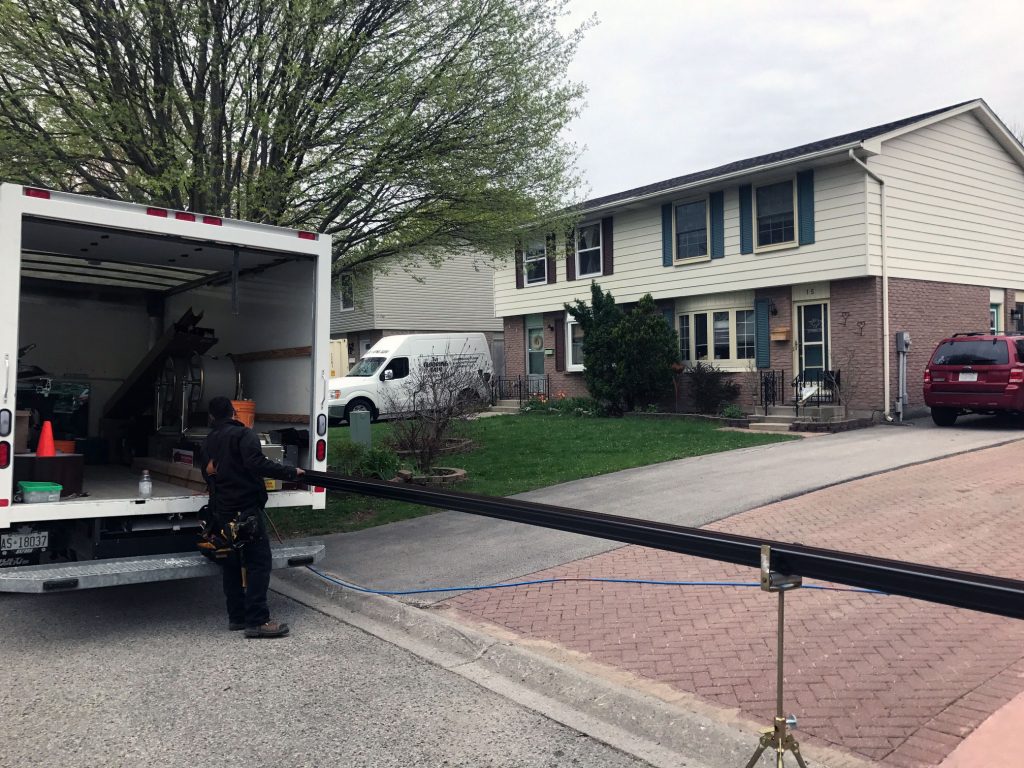
We use heavier-gauge aluminum coil rather than the thinnest stock available. It costs us more per foot and it’s the reason our gutters hold their shape under an ice load instead of sagging away from the fascia. See our full eavestrough and gutter installation service for details.
Corners: Where Gutters Actually Fail
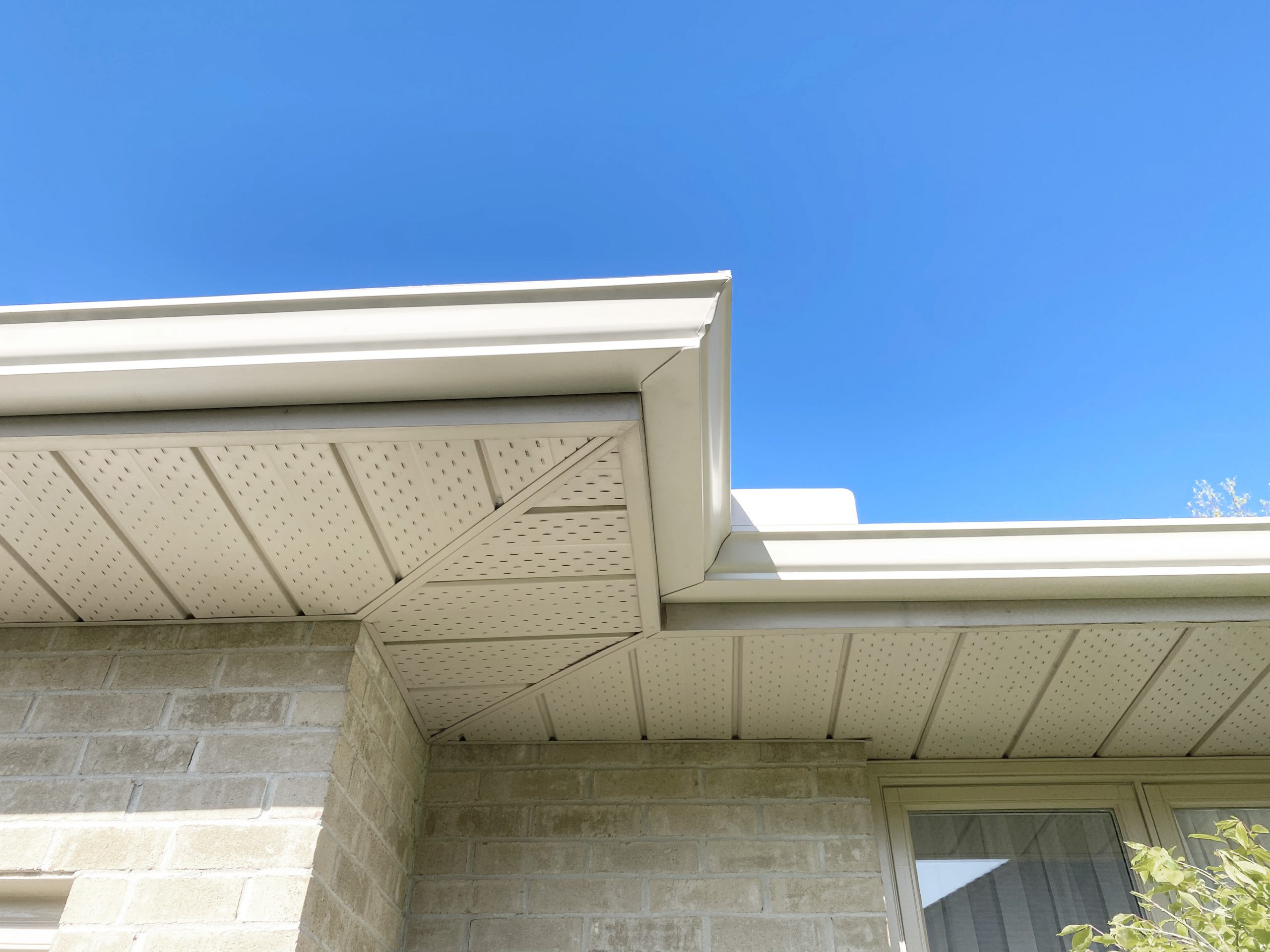
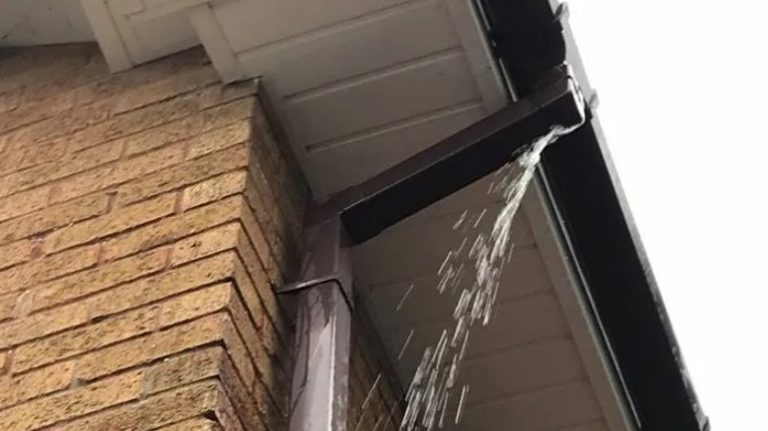
Almost every leaking eavestrough we get called out to repair in London is leaking in the same place: a corner.
A seamless gutter is only seamless along the run. At every inside and outside corner, two lengths of aluminum have to be joined — and that joint sits at the exact spot where water changes direction, slows down, and pools. It’s also the spot that takes the most punishment from a Southwestern Ontario winter, as the aluminum expands and contracts and ice loads up in the turn.
When a corner isn’t built right, here’s what shows up:
- A slow drip that stains the fascia and rots it from behind (fascia board rot almost always starts at a corner)
- Water running down the exterior wall instead of into the downspout
- Ice building at the corner in winter and prying the joint further open
- Saturated soil at the foundation directly below
Why this is the part you’re really paying for
Anyone can hang a straight run of gutter. The corners are where installations separate themselves, and they’re the reason we don’t treat any two houses the same.
How a corner gets formed, joined, supported, and sealed depends on the roofline it’s turning, the size of the system, how much water is moving through it, and what the fascia behind it is like. Those decisions get made on site by the installer standing in front of it — not from a template. On one home the right approach is one thing; twenty feet down the street on a different roofline it’s another.
What doesn’t change is the standard the finished corner has to meet: a watertight joint that stays watertight through years of thermal movement and ice, properly supported so it can’t sag and reverse the pitch, and pitched so water keeps moving through the turn to the downspout instead of sitting in it.
That’s judgment built over 23 years of London rooflines, and it’s the difference between eavestroughs you stop thinking about and eavestroughs you’re calling someone about in three years.
What Actually Changes Your Price
1. Linear footage
The single biggest factor. More roofline, more gutter.
2. 5-inch or 6-inch
The jump from 5″ to 6″ is significant — roughly double per foot. It’s more aluminum, a heavier system, larger downspouts, and a slower install. It’s absolutely worth it on the right house and a waste of money on the wrong one. See the sizing section below.
3. Height, pitch, and access
A single-storey ranch with clear access around all four sides is a straightforward day. A three-storey with a steep pitch, a walkout backing onto a slope, mature trees, or a neighbouring house eighteen inches off your wall means more staging, more safety equipment, and more time. London’s older neighbourhoods — Old North, Wortley Village, Blackfriars — have plenty of homes in that second category.
4. What we find behind the old gutters
This is the most common source of a quote changing. Failing eavestroughs have usually been dripping onto the fascia for years. If the wood behind them is soft, there’s nothing solid to fasten new gutters to. We’ll show you the damage and quote the soffit and fascia work separately so you can decide.
5. Downspouts and where they discharge
Pricing can vary slightly depending on how many downspouts your home needs and how far each one has to run. A downspout that drops straight to grade is simple. One that has to travel across the front of the house, around a bay window, or out to a drainage point away from the foundation costs more. Details in our London downspout service guide.
6. Gutter guards
Priced per foot on top of the gutter. Worth it on a treed lot, hard to justify on a bare one. See gutter guards and Eavestrough Problems Solved with Gutter Guards.
7. Add-ons
Splash guards at inside corners on steep roofs, extensions, custom colour matching, and capping to finish the fascia.
5-Inch or 6-Inch: How to Decide
Most London homes are properly served by 5-inch. Going bigger isn’t automatically better — an oversized gutter on a small roof just costs more and looks heavy on the fascia line.
Stick with 5-inch if:
- You have a standard roof pitch and typical-sized roof planes
- Your current gutters only overflow because they’re clogged or improperly pitched
- You’re on a bungalow, semi, or standard two-storey
Consider 6-inch if:
- You have large, unbroken roof planes dumping into a single run
- Your roof is steeply pitched — water arrives faster and can overshoot a 5-inch gutter
- Two roof sections funnel into one valley that discharges into one length of gutter
- Your existing properly-installed, properly-cleaned 5-inch gutters still overflow in a heavy summer downpour
- You have a metal roof, which sheds water fast
A quick note: overflowing gutters are diagnosed as an undersizing problem far more often than they really are one. Most of the time it’s clogging, bad pitch, or a downspout that can’t keep up. We’d rather tell you that than sell you 6-inch you don’t need. That’s what the free inspection is for.
Downspouts: The Half Nobody Quotes On
The gutter catches the water. The downspout is what decides where it ends up.
- How many: roughly one every 30 to 40 feet of run, more on a large or steeply pitched roof.
- What size: larger downspouts move more water and clog less often. On a 6-inch system, an oversized downspout isn’t optional — a big gutter feeding an undersized outlet just backs up at the corner.
- Where they end: water needs to be carried away from the foundation. A downspout emptying against a London basement wall is a wet-basement call waiting to happen, and it’s a cheap fix at install time.
Repair or Replace?
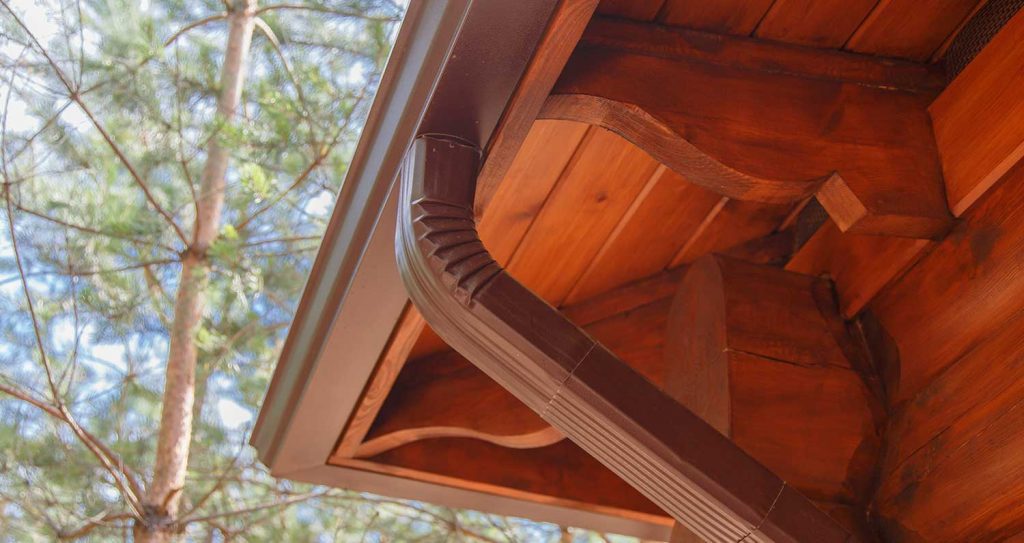
Not every home needs a full replacement. A section of gutter that’s pulled loose, a failed corner joint, or a downspout that’s separated is a repair, and it costs a fraction of a replacement.
Repair usually makes sense when: the aluminum is sound, the problem is isolated to one run or one joint, and the fascia behind it is solid.
Replace when:
- Sections sag, hold standing water, or have pulled away from the fascia
- Seams and corners are separating in more than one place
- You’re seeing rust or splits (typical of old steel or vinyl systems)
- Water runs behind the gutter and down the wall
- Peeling paint, stained siding, or moisture in the basement below a specific gutter run
- It was last replaced 20+ years ago
We walk through this in more detail in Eavestrough Repair vs. Replacement.
Why We Retired Our Online Cost Calculator
For years this site had a gutter cost calculator. We’ve taken it down, and we want to explain why.
It asked for footage, size, and a few add-ons, and produced a number. The problem is that the things it couldn’t see were often the things that mattered most — the condition of the fascia behind the existing gutters, the pitch of the roof, how the downspouts had to be routed, whether the previous install had been leaking into the wall for five years.
The calculator gave people confident-looking numbers that our estimator then had to walk back on site. That’s a bad experience, and it isn’t how we want to price work. So it’s gone.
What replaced it: the honest per-foot ranges at the top of this page, so you can plan, and a free on-site inspection for the actual number. We measure everything, check the whole drainage system — gutters, soffit, fascia, downspouts, capping, siding — and give you a written quote with the work itemized.
Book your free inspection or call 519-873-0057.
When to Book (and Why Timing Affects What You Pay)
Our price per foot doesn’t change with the season, but waiting costs money.
- Spring is our busiest stretch. Everyone discovers their gutter problem during the first heavy April rain. Book early for a spring install.
- Summer is the easiest time to schedule and the best conditions for sealing corners — sealant cures properly in warm, dry weather.
- Fall is the deadline that matters. Gutters that are failing in October will be failing under an ice load in January, and ice turns a small separation into a torn-off section. Our fall eavestrough maintenance guide covers what to check.
- Winter installs are possible but weather-dependent.
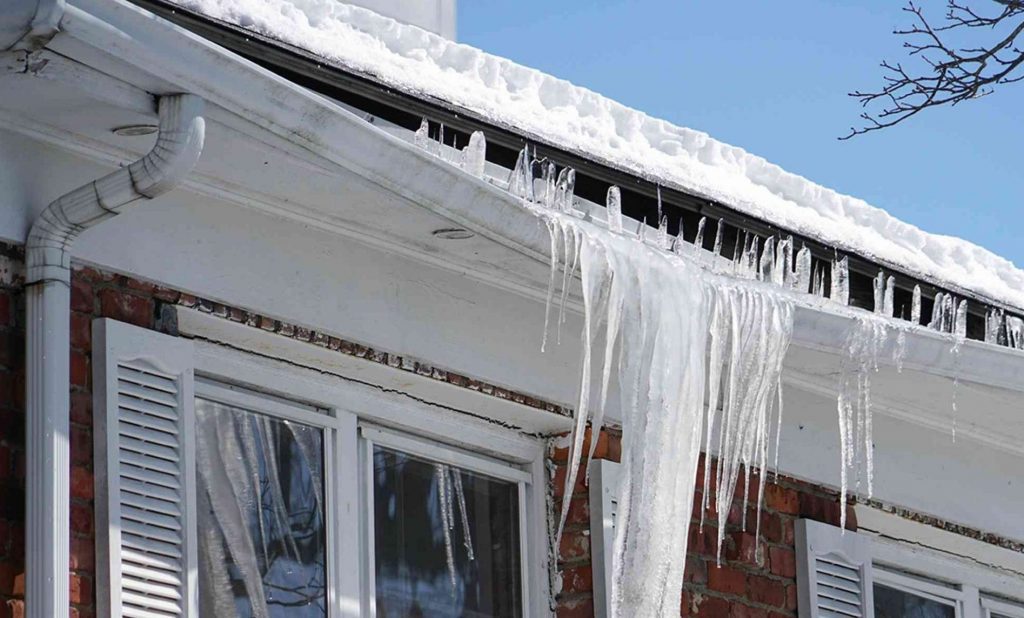
The real cost of putting it off isn’t the gutter. It’s the rotted fascia, the soaked soffit, the ice damming, the stained siding, and the water finding its way into a London basement. All of those cost more to fix than the eavestrough would have.
Where We Work
Only Eavestroughs installs throughout London, Ontario and the surrounding area, including St. Thomas, Port Stanley, Ilderton, Lucan, Komoka, Strathroy, Mount Brydges, Thorndale, Ingersoll, and Aylmer.
We’ve been doing this since 2003 — fully insured, BBB A+ accredited, and a Consumer Choice Award winner. Have a look at our work.
Frequently Asked Questions
In 2026, seamless aluminum eavestroughs cost $10 to $15 per linear foot for 5-inch and $20 to $25 per linear foot for 6-inch, installed, including removal and disposal of your old gutters. Most London homes fall between $1,200 and $3,000 for a full 5-inch replacement.
Because a corner is a joint, and it sits where water changes direction, slows down, and pools — while taking the worst of the freeze-thaw and ice load each winter. It’s the hardest part of the system to get right and the first place a rushed installation shows up. How each corner is built is decided on site based on that specific roofline.
Most London homes are well served by 5-inch. 6-inch makes sense for large or steeply pitched roofs, long unbroken runs, or homes where clean, correctly pitched 5-inch gutters still overflow in heavy rain. It roughly doubles the per-foot cost, so it’s worth confirming during the inspection rather than guessing.
We install seamless aluminum only. It doesn’t rust, it handles Southwestern Ontario’s freeze-thaw cycles, it’s formed seamless on site, and it delivers the best lifespan for the money on a residential home here. Steel rusts, and copper and zinc carry a large premium most London homeowners never recoup.
Yes. Teardown, disposal, and cleanup are included in our pricing at no extra charge.
Most homes are completed in a single day. Large homes, multiple rooflines, difficult access, or fascia repair can extend that.
Properly installed and kept clear, 20 to 30 years. The failures we see early are almost always installation-related — bad pitch, too few hangers, or a poorly built corner.
On a treed lot, yes — they dramatically cut how often the system needs cleaning and reduce the ice and overflow problems that come from clogging. On an open lot with no overhanging trees, they’re harder to justify.
Yes. Every quote starts with a free, no-obligation on-site inspection of your full drainage system, and comes to you in writing with the work itemized.
Ready for a Real Number?
Use the per-foot ranges above to plan your budget, then let us measure. We’ll inspect the whole system, show you what we find, and put a written price in your hands with no obligation.
Call 519-873-0057 or book your free inspection online.
Only Eavestroughs — London, Ontario. Serving homeowners since 2003.